

There are watches that evolve slowly, refining familiar codes over decades. And then there is the Cartier Crash — a design so deliberately distorted it feels like Cartier abandoned geometry altogether and chose emotion instead. Now, one of the rarest known examples of this surreal icon has achieved a record-breaking $2 million at auction, firmly positioning it at the intersection of horology, art, and cultural mythology.
For collectors, this isn’t just another headline-grabbing sale. It’s the confirmation of something the market has been quietly moving toward for years: watches that prioritize radical design language and provenance are now competing at the very highest level of collecting.

The Cartier Crash Explained: A Design That Broke the Rules
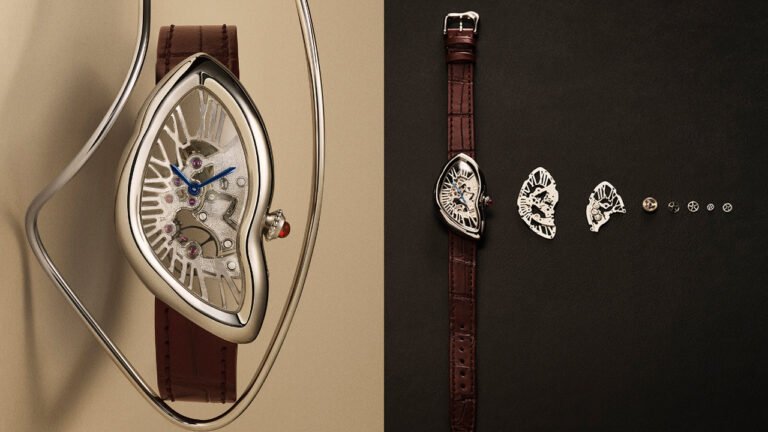
First introduced in London during the late 1960s, the Cartier Crash is widely considered one of the most audacious design experiments in watchmaking. Its origin story is already part of horological folklore — often linked to a distorted Cartier Baignoire — but what matters more is what it represents: a refusal to obey symmetry, proportion, or traditional watch logic.
The Crash looks almost fluid. Its case appears stretched and melted, Roman numerals bend unnaturally across the dial, and time itself seems visually destabilized. And yet, despite its surreal appearance, it remains unmistakably Cartier — elegant, restrained in execution, and deeply intentional.
Over the decades, the Crash has been revisited in extremely limited runs, each iteration reinforcing its status as one of the maison’s most elusive creations. But the example that just set a new auction record sits in a category of its own entirely.
The 1987 London Crash: A Once-in-a-Lifetime Piece
This particular watch is one of an exceptionally small number of special Crashes produced in London in the late 1980s. While exact production numbers remain unclear, Cartier’s Geneva archives from 2017 indicate that it is believed to be one of only three pieces specially commissioned in 1987.
That alone places it in the highest tier of Cartier rarity.
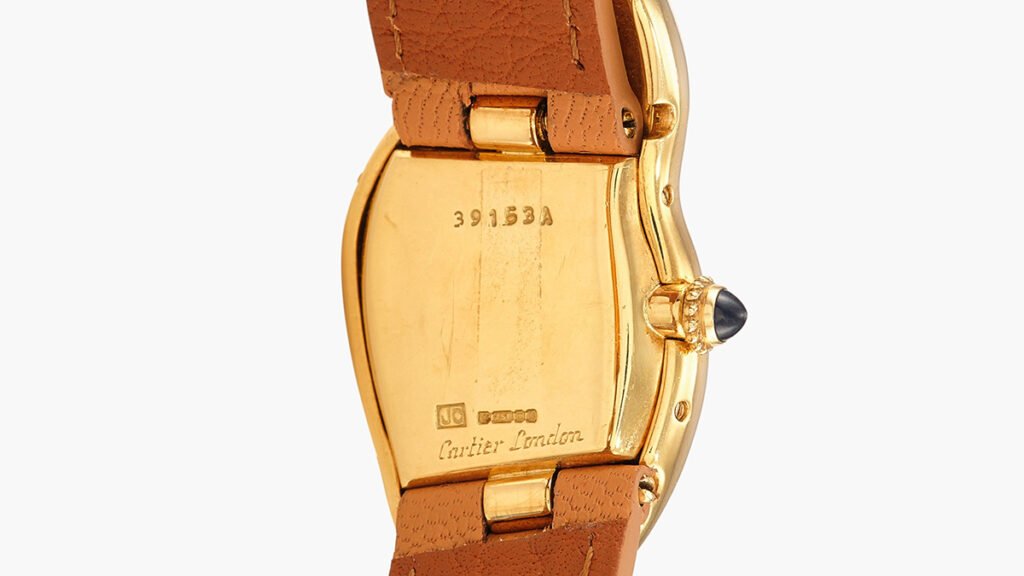
The watch features the signature melted yellow-gold case, paired with a white asymmetrical dial that carries the unmistakable distorted Roman numerals and the coveted “Cartier London” signature — a detail that instantly elevates its historical significance. Further reinforcing its uniqueness is a sapphire-set crown, a gold caseback engraved with London hallmarks, and a brown leather strap that preserves the understated elegance beneath the avant-garde case design. Inside, the watch is powered by a Jaeger-LeCoultre calibre 841, a hand-wound movement signed by Cartier — a reminder that beneath its radical exterior lies serious horological pedigree.
The Cartier Crash is often discussed as a design object first and a watch second, but this 1987 London example elevates that conversation even further. Every element feels deliberately unbalanced yet meticulously crafted.
The yellow-gold case retains its iconic “melted” silhouette, while the dial’s warped numerals appear almost hand-painted in motion. The inclusion of “Cartier London” on the dial is particularly important, anchoring the piece to one of the most creatively free periods in the brand’s modern history.
Even the sapphire-set crown adds to the contradiction: an element of refinement embedded within a deliberately chaotic visual language.

Key Specifications
- Model: Cartier Crash (London special edition, 1987)
- Case Material: Yellow gold
- Case Design: Asymmetrical “melted” Crash form
- Dial: White asymmetrical dial with distorted Roman numerals
- Movement: Jaeger-LeCoultre calibre 841, hand-wound, signed by Cartier
- Strap: Brown leather
This combination of London production, archival rarity, and movement pedigree places the watch in a category few Cartier pieces can even approach.
Why This Sale Matters
The $2 million result is more than a record — it’s a recalibration of how the market defines value in modern collecting. The Cartier Crash has always existed slightly outside traditional horological frameworks, appealing as much to design collectors and art buyers as to watch enthusiasts.
But this 1987 London example introduces something even more powerful: documented scarcity paired with cultural mythology. When a watch is believed to exist in only three examples, and one carries this level of provenance, it stops behaving like a luxury object and starts behaving like a historical artifact.
The result reinforces a broader trend in collecting: watches with strong narrative identity and radical design language are increasingly outperforming technically complex but visually conservative pieces at auction.
A Watch That Refuses to Be Measured
Following the sale, attention has intensified around Cartier’s most experimental design periods, particularly the London workshop era, which produced some of the maison’s most unconventional creations. The Crash sits at the center of that legacy, bridging experimental design, fine watchmaking, and cultural storytelling in a way few watches ever have.
For collectors, this sale also signals a deeper shift in sentiment. The most valuable watches today are not always the rarest in production — but the ones that feel irreplaceable in meaning.
The Cartier Crash was never designed to be rational. It was designed to be felt, interpreted, and remembered. This 1987 London example embodies that philosophy at its most extreme, and its $2 million result confirms what the market has been slowly acknowledging: emotional design can be just as powerful as mechanical complexity.
In a collecting landscape increasingly defined by storytelling, the Crash isn’t just holding its place — it’s redefining the conversation entirely.