
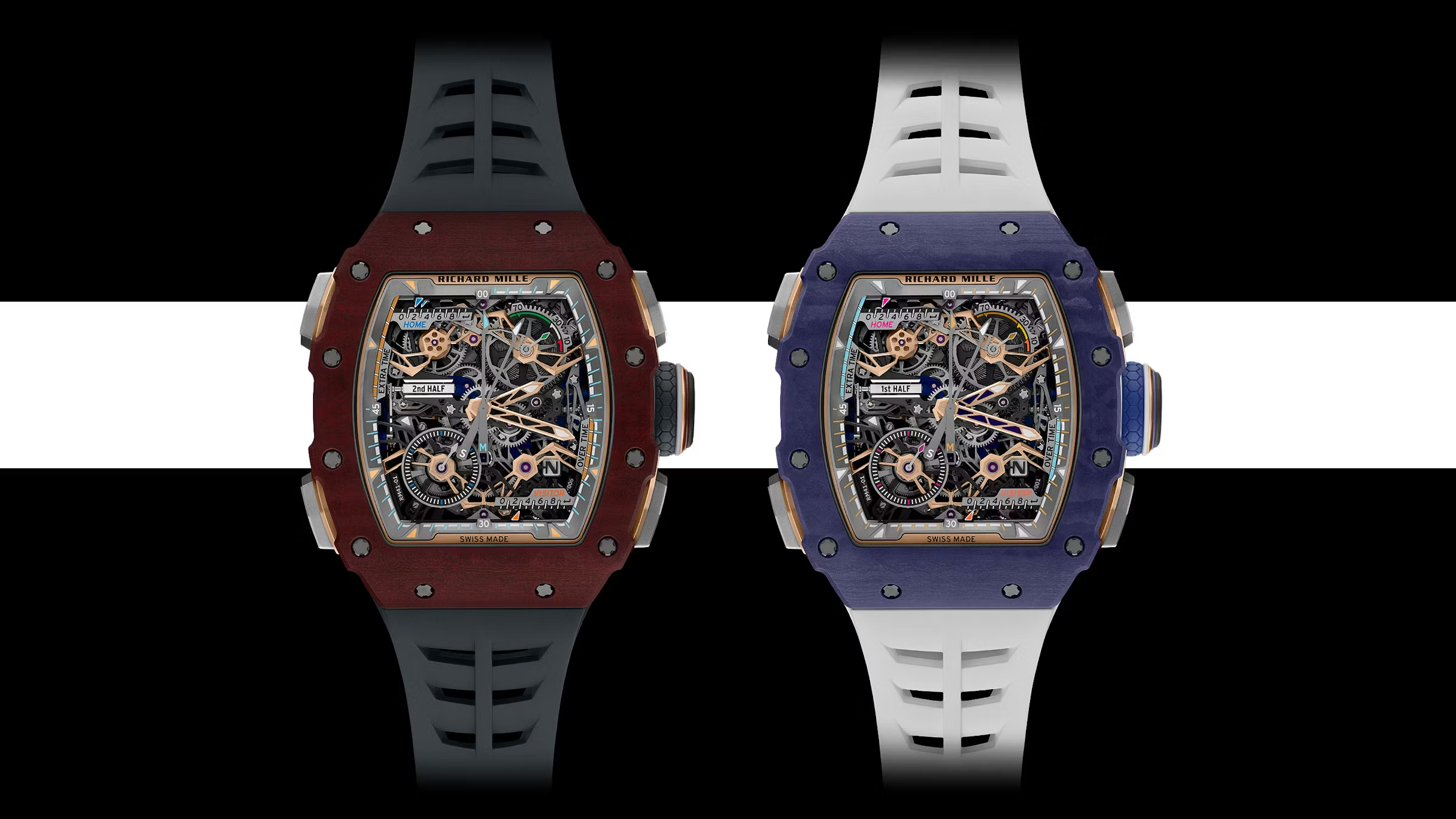
In a watch industry that often equates innovation with materials or aesthetics, true functional novelty is rare. That’s why the new RM 41-01 Tourbillon Soccer from Richard Mille landed like a thunderclap. It doesn’t just look technical—it introduces an entirely new complication concept: a fully mechanical system designed to track a football match in real time.
This isn’t a themed watch. It’s a mechanical instrument purpose-built for the sport.
A Complication That Didn’t Exist Before
Sports watches typically measure elapsed time. The RM 41-01 does something more nuanced: it mirrors the structure of an actual match. Using a network of pushers and cams integrated into the movement, the wearer can track first half, stoppage time, halftime, second half, and extra time—all mechanically programmed into the calibre’s architecture.
The display is unusually legible for such complexity. A central hand tracks match minutes, while additional indicators signal period changes and stoppage phases. The system effectively acts as a mechanical referee’s console on the wrist, translating the logic of football timing into gear trains and levers.
From a horological standpoint, that’s the real story. Complications traditionally display astronomical, calendrical, or chronometric data. Designing one around a sport required inventing an entirely new mechanical language.
Inside the RM 41-01 Calibre
At the core lies a manually wound tourbillon movement developed specifically for this model. The base architecture follows Richard Mille’s signature approach: a skeletonized titanium baseplate, bridges engineered for rigidity, and shock-resistant construction intended to withstand real-world wear rather than museum storage.
The tourbillon isn’t decorative—it stabilizes rate consistency despite the additional load from the match-tracking mechanism. Integrating both systems required careful torque management so that activating timing functions wouldn’t disrupt amplitude.
Key Specifications
- Movement: Manual-winding RM41-01 calibre
- Regulator: Tourbillon escapement
- Power Reserve: ~70 hours
- Baseplate/Bridges: Grade 5 titanium
- Functions: Match timer, stoppage time, period indicator, function selector, torque indicator
- Construction: Shock-resistant architecture
Case Engineering and Materials
Richard Mille cases are as engineered as their movements, and the RM 41-01 continues that tradition. The tonneau-shaped case uses layered composite materials such as Carbon TPT or Quartz TPT, depending on the edition. These ultra-light laminates are prized for strength-to-weight ratio and resistance to thermal expansion—qualities particularly relevant for a watch meant to be operated repeatedly during timing sequences.
Despite the complexity inside, ergonomics remain a priority. The pushers are shaped and positioned for intuitive use, each corresponding to a specific match phase. Water resistance and structural integrity meet the brand’s usual sport-watch standards, meaning the watch isn’t just symbolic—it’s functional in active environments.
Case Specifications
- Material: Carbon TPT or Quartz TPT composite
- Construction: Tripartite case with spline screws
- Dimensions: Richard Mille tonneau profile (large-format sport case)
- Crystal: Sapphire front and back
- Strap: Integrated rubber
A Mechanical Thought Experiment Made Real
The RM 41-01 Tourbillon Soccer could easily have been a gimmick. In less capable hands, it might have been. Instead, it demonstrates what happens when avant-garde engineering meets a clear conceptual brief. Every lever, wheel, and pusher serves a purpose tied to the logic of a match.
That’s what makes it compelling. Not the tourbillon. Not the materials. The idea.
Because ultimately, the most exciting watches today aren’t just complicated. They’re imaginative. And this one proves that even in 2026, mechanical watchmaking can still invent something genuinely new.